
When you import glass bottles by sea, one number matters more than any other: how many bottles actually fit in the container. Most first-time buyers assume volume determines the answer. In practice, glass bottles almost always hit the container's weight limit long before the space runs out. Understanding this one distinction is how you cut per-unit freight cost by 15–30%. For the broader context on planning your first shipment from China, including lead times and Incoterms, see our sourcing guide.
Container Types and What They Hold
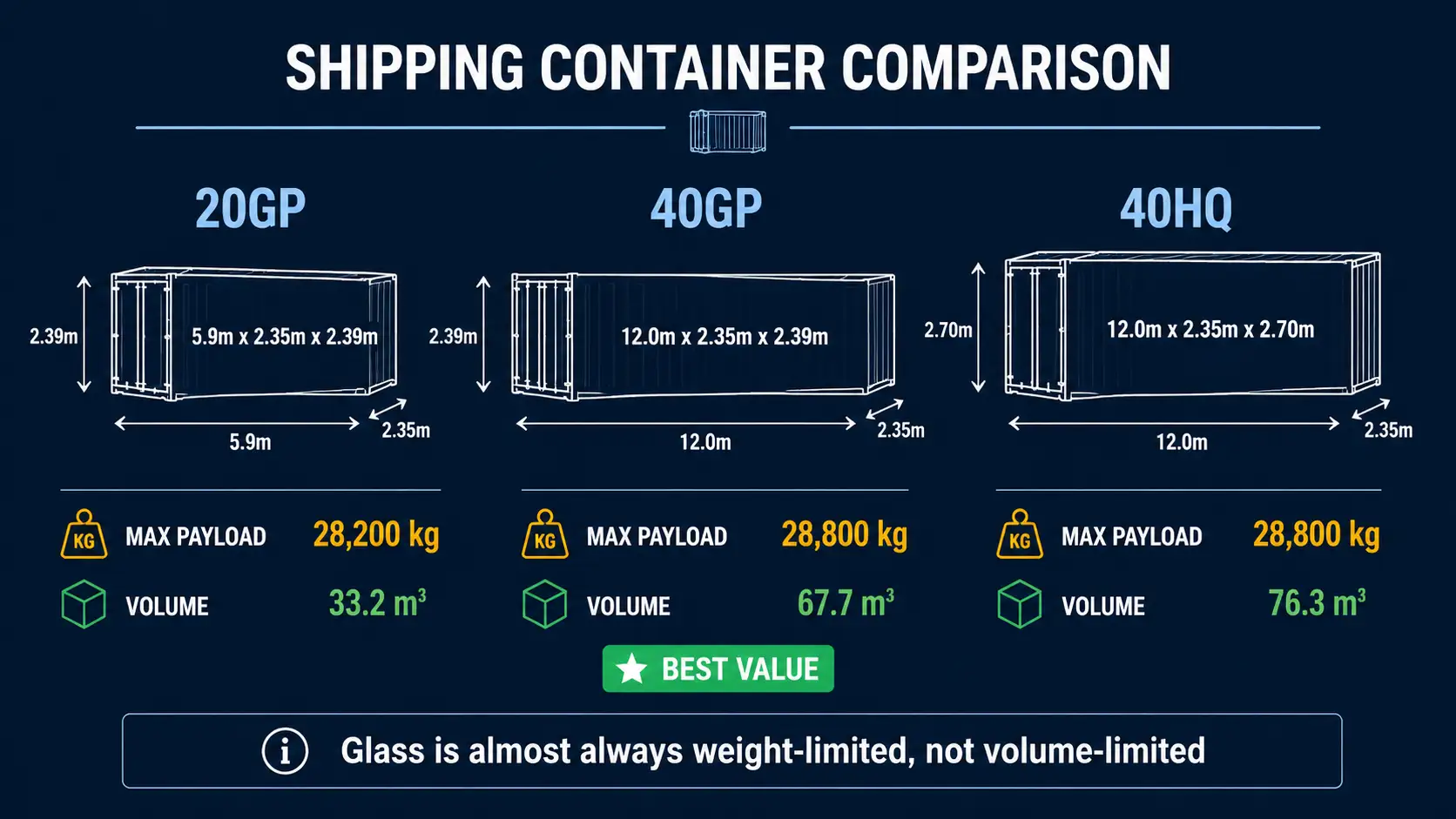
Three standard dry container sizes are used for glass bottle shipping:
- 20GP: 5.9m × 2.35m × 2.39m internal. Max payload ~28,200 kg. Volume 33.2 m³.
- 40GP: 12.0m × 2.35m × 2.39m internal. Max payload ~28,800 kg. Volume 67.7 m³.
- 40HQ (High Cube): 12.0m × 2.35m × 2.70m internal. Max payload ~28,800 kg. Volume 76.3 m³.
Here's the non-obvious part: a 40GP has nearly double the volume of a 20GP but only ~600 kg more payload. For heavy goods like glass, the 40GP is almost always the better deal. You get roughly 2× the bottle capacity for only ~30% more freight cost.
Weight-Limited vs. Volume-Limited
A container is volume-limited when it's physically full before hitting the weight cap. It's weight-limited when the weight cap is reached with empty space remaining.
Glass bottles weigh 50–1,500g each, plus carton weight, plus pallet weight. Even small bottles eat into the payload fast. Some real numbers:
- 750ml wine bottle (460–560g): 20GP holds ~20,000–25,000 bottles. The container is only 40–50% full by volume. The rest is air you paid to ship.
- 100ml Boston Round (85–100g): 20GP holds ~60,000–80,000 bottles. Getting closer to volume limit, but still probably weight-limited.
- 50ml dropper (85–108g): 20GP holds ~50,000–65,000 bottles.
Rule of thumb: if your bottles weigh more than 300g each, assume weight-limited loading. Plan accordingly.
How Loading Actually Works
Bottles go into cartons (typically 6, 12, or 24 per carton). Cartons go onto pallets. Pallets go into the container. Every step in this chain is an optimization opportunity.
- Carton size is determined by bottle dimensions and how many go in each carton.
- Pallet pattern depends on how the cartons tile on a standard pallet (usually 1200 × 800mm Euro or 1200 × 1000mm industrial).
- Stacking height is limited by bottle vertical load capacity and container height.
How many pallets fit:
- 20GP: ~10 standard pallets single-stacked, ~20 double-stacked (if weight allows).
- 40GP: ~20 standard pallets single-stacked, ~40 double-stacked.
- 40HQ: Same pallet count as 40GP, but more vertical room for taller cartons.
Five Strategies to Get More Bottles Per Container
1. Reduce Bottle Weight (Lightweighting)
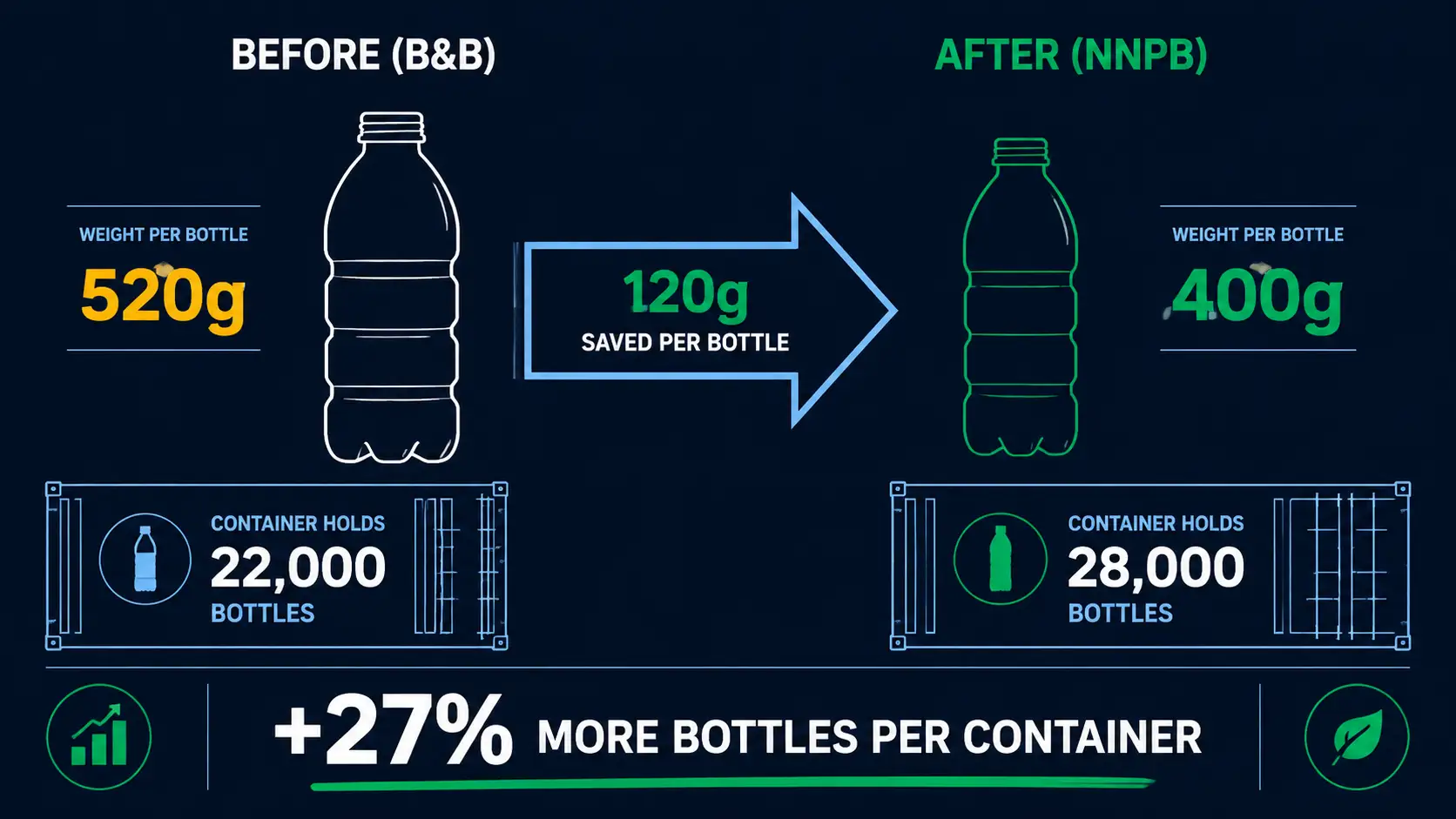
This is the single highest-impact move. Switching from Blow-and-Blow (B&B) to Narrow Neck Press-and-Blow (NNPB) can cut bottle weight by 20–35% without changing how the bottle performs. Less weight per bottle means more bottles before the container hits its payload limit.
Real example with a 750ml Bordeaux bottle:
- At 520g: ~22,000 bottles per 20GP.
- Lightweighted to 400g: ~28,000 bottles per 20GP.
- That's 27% more product per container — which translates directly to 27% lower per-unit freight.
Ask your supplier if they offer NNPB for your bottle shape. Not all shapes qualify, but most standard rounds do. Our lightweighting calculator lets you model the savings for your specific bottle.
2. Optimize Carton Configuration
Carton dimensions decide how many cartons fit on a pallet, which decides how many pallets fit in the container. Small improvements compound across dozens of pallets:
- Test different bottle-per-carton counts (6, 12, 24) to find the one that minimizes wasted pallet space.
- Carton dimensions should tile evenly on the pallet. A carton that leaves 5cm gaps on each side loses significant space multiplied across 20+ pallets.
- For round bottles, hexagonal or staggered packing inside the carton can fit 5–10% more bottles per box.
3. Pick the Right Container Size
- Under 15,000 bottles: 20GP is usually enough.
- 15,000–50,000 bottles: 40GP gives the best per-unit cost.
- Tall bottles or tall cartons: 40HQ adds 31cm of internal height.
- Always compare per-unit freight: total container cost ÷ bottles inside. The 40GP wins on unit economics almost every time.
4. Use Mixed Loading
If you're ordering multiple bottle sizes, combine them in one container to fill both weight and volume more evenly. Heavy, compact bottles (small droppers, jars) go on the bottom. Lighter, taller bottles (wine bottles) go on top. The goal is to approach both the weight cap and the volume cap simultaneously.
5. Understand How Freight Is Priced
FCL (full container load) ocean freight is quoted per container — not per kg, not per m³. A half-empty 40GP costs the same as a full one. Every empty slot is money wasted.
LCL (less-than-container-load) freight is quoted by volume or weight, whichever is greater. Glass bottles almost always trigger the weight rate. Build this into your cost model from the start.
The Checklist
Before placing your order, ask your supplier for:
- Exact carton dimensions (L × W × H in mm).
- Bottles per carton and carton weight (kg).
- Pallet type (Euro or industrial), bottles per pallet, and total pallet height.
- Recommended container type and estimated total units per container.
- Weight of a loaded pallet — confirm it's under the container's floor load limit.
Plug these numbers into a container loading calculator. The 30 minutes you spend on this exercise can save thousands in annual freight costs — and it takes the guesswork out of your per-unit cost model. You can use our container loading calculator to run the numbers.