China makes more glass containers than any other country. Factories in Shandong, Jiangsu, and Guangdong push 80–120 million units per line per year, with FOB prices running 30–50% below European equivalents. The savings are real. But so are the pitfalls — first-time buyers lose money on mistakes that experienced sourcing managers learned to avoid years ago.
Here are the 12 we see repeatedly, based on conversations with buyers and suppliers in the glass packaging industry.
1. Taking the Factory at Face Value
A polished Alibaba storefront doesn't mean much. Many "manufacturers" are trading companies — they mark up 15–30% and give you zero visibility into what's actually happening on the production floor. Before you place an order:
- Ask for their business license (营业执照). The registered scope should list glass manufacturing, not just "trading" or "import/export."
- Request their ISO 9001 certificate and verify it. Valid certificates are searchable on the CNCA database — fake certificates are more common than you'd think.
- Get a factory audit report from a third party (SGS, TÜV, Intertek). If they refuse or drag their feet, that tells you something.
Trading companies aren't inherently bad — some offer real value with consolidation, logistics, and English-speaking support. But you should know which one you're dealing with, because the price and control dynamics are different.
2. Ignoring MOQ Reality
Chinese glass factories are built for volume. A single furnace runs 24/7 and melts 150–400 tonnes of glass per day. Pulling a production line for a small order doesn't make economic sense for them, so they set minimums accordingly:
- Standard shapes with shared molds (Boston Round, Bordeaux): MOQ 5,000–10,000 units.
- Custom molds: MOQ 20,000–50,000 units.
- Specialty colors (cobalt blue, frosted): MOQ often 1.5–2× the standard, because the furnace has to be flushed and re-charged for the color change. See our glass color and cost guide for how each color affects pricing and lead times.
If you need fewer than 5,000 units, your best bet is a distributor or sourcing agent who consolidates orders from multiple buyers.
3. Paying 100% Upfront
Standard payment terms for first orders in China's glass industry look like this:
- 30% deposit with the purchase order.
- 70% balance against the bill of lading (B/L) copy, before the ship sails.
- Some factories accept a letter of credit (L/C) for orders above $20,000.
If a supplier wants 100% T/T upfront, walk away. Full prepayment eliminates your leverage entirely. If quality problems surface mid-production — and they do — you have no cards left to play.
4. Not Pinning Down Incoterms
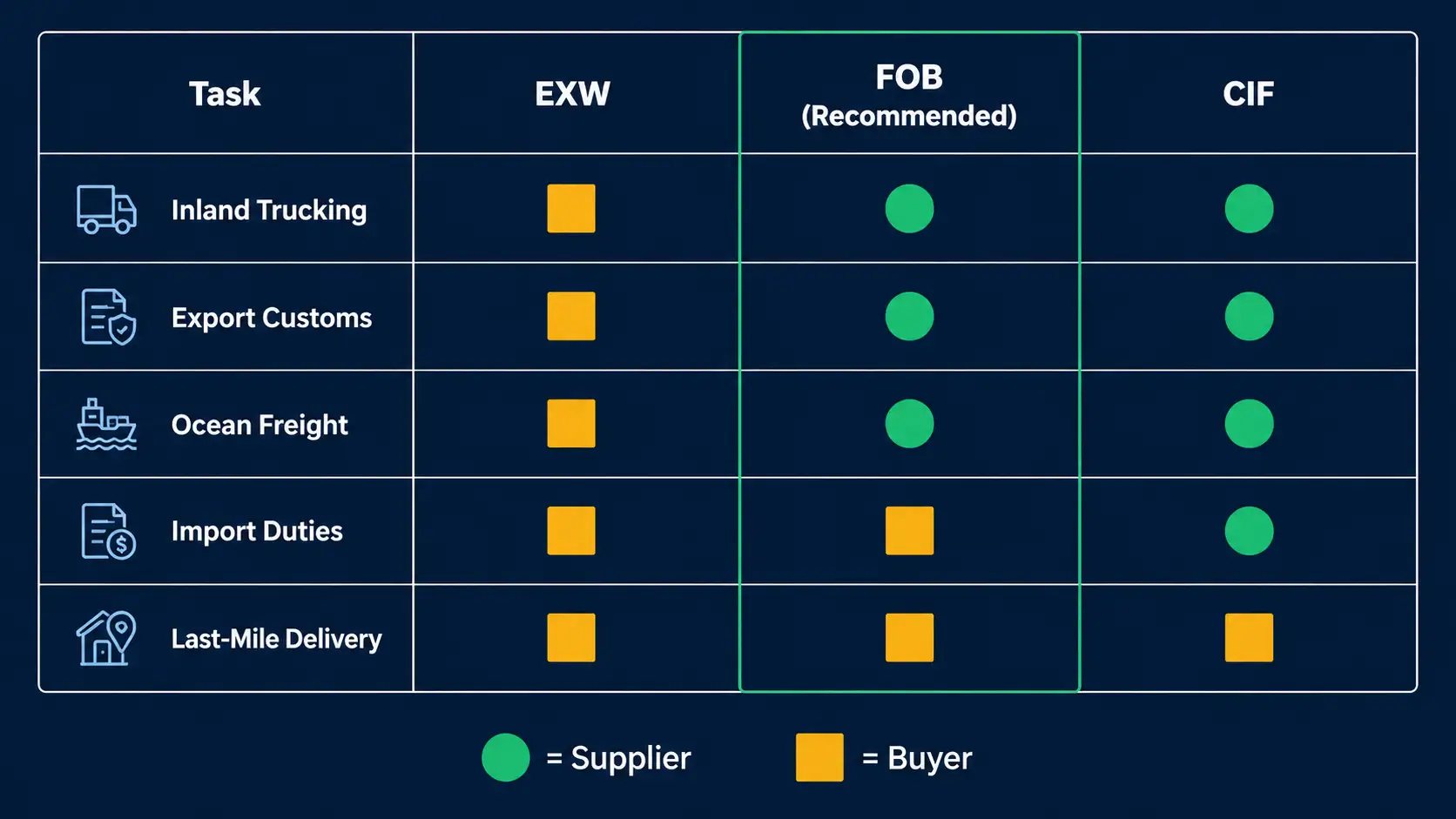
FOB (Free on Board) is the standard for glass bottle exports from China. But first-time buyers frequently get quoted EXW (Ex Works) without realizing it, then discover they're on the hook for arranging and paying for inland trucking, customs clearance, and export documentation.
Know what each term means:
- EXW: You pick up at the factory gate. You handle everything: trucking, customs, freight, documentation.
- FOB: Supplier delivers to the port and handles export clearance. You pay ocean freight from there.
- CIF: Supplier pays freight to your destination port. You pay import duties and last-mile delivery.
For a first order, FOB is the safest balance of cost and control. It's also the most common, so pushing for it rarely meets resistance.
5. Skipping Samples
Always order samples before committing to production. Two types matter:
- Existing samples: Usually free (you pay express shipping, roughly $30–60). Arrives in 3–7 days. Confirms the factory's standard quality level.
- Custom samples: $200–500 plus mold fee if needed. Takes 7–14 days. Confirms your specific design.
When you receive samples, measure everything: height, diameter, wall thickness, neck finish inner diameter, weight. Compare against the spec sheet. A 1mm deviation in neck ID means your caps won't seal. We've seen this happen more than once — it's an expensive problem when it shows up in a 50,000-unit order. Our neck finish compatibility guide explains why a "28mm" cap doesn't always fit a "28mm" bottle and how to specify dimensions correctly.
6. Not Requesting a Pre-Production Sample
A catalog sample tells you the factory can make bottles. A pre-production sample (PP sample) tells you what your batch will look like. Always approve a PP sample before full production starts.
The PP sample locks in:
- Exact glass color and clarity
- Neck finish dimensions
- Wall thickness distribution
- Surface quality (seam lines, scratches, bubbles)
If the factory pushes back on providing a PP sample, that's a warning sign.
7. Skipping Third-Party Inspection
Don't rely on the factory's own QC department. Hire a third-party inspection company (SGS, QIMA, AsiaInspection) for a pre-shipment inspection (PSI). A standard PSI covers:
- AQL 2.5 Level II sampling: Statistically valid batch inspection.
- Dimensions: Height, diameter, neck ID/OD, wall thickness.
- Visual defects: Bubbles, stones, cracks, chips, sink marks, foreign inclusions.
- Functional tests: Leakage test, thermal shock resistance, vertical load.
Reject rates vary by factory tier. Top-tier Chinese factories run 2.5–4.5% reject. Mid-tier can hit 6–10%. Without independent inspection, you're trusting the factory to grade its own homework.
8. Forgetting Mold Ownership
If you paid for a custom mold, it belongs to you. But without explicit written terms, some factories will:
- Claim the mold as their property after your order wraps.
- Use your mold to produce bottles for other customers — potentially your competitors.
- Charge a "storage fee" ($50–200/month) to hold your mold.
Put mold ownership in your purchase contract. Include the right to retrieve the mold at any time, and prohibit the factory from using it for other customers without your written consent. For a deeper dive on mold pricing, shared vs. custom options, and cavity counts, see our glass bottle mold cost guide.
9. Underestimating Lead Times
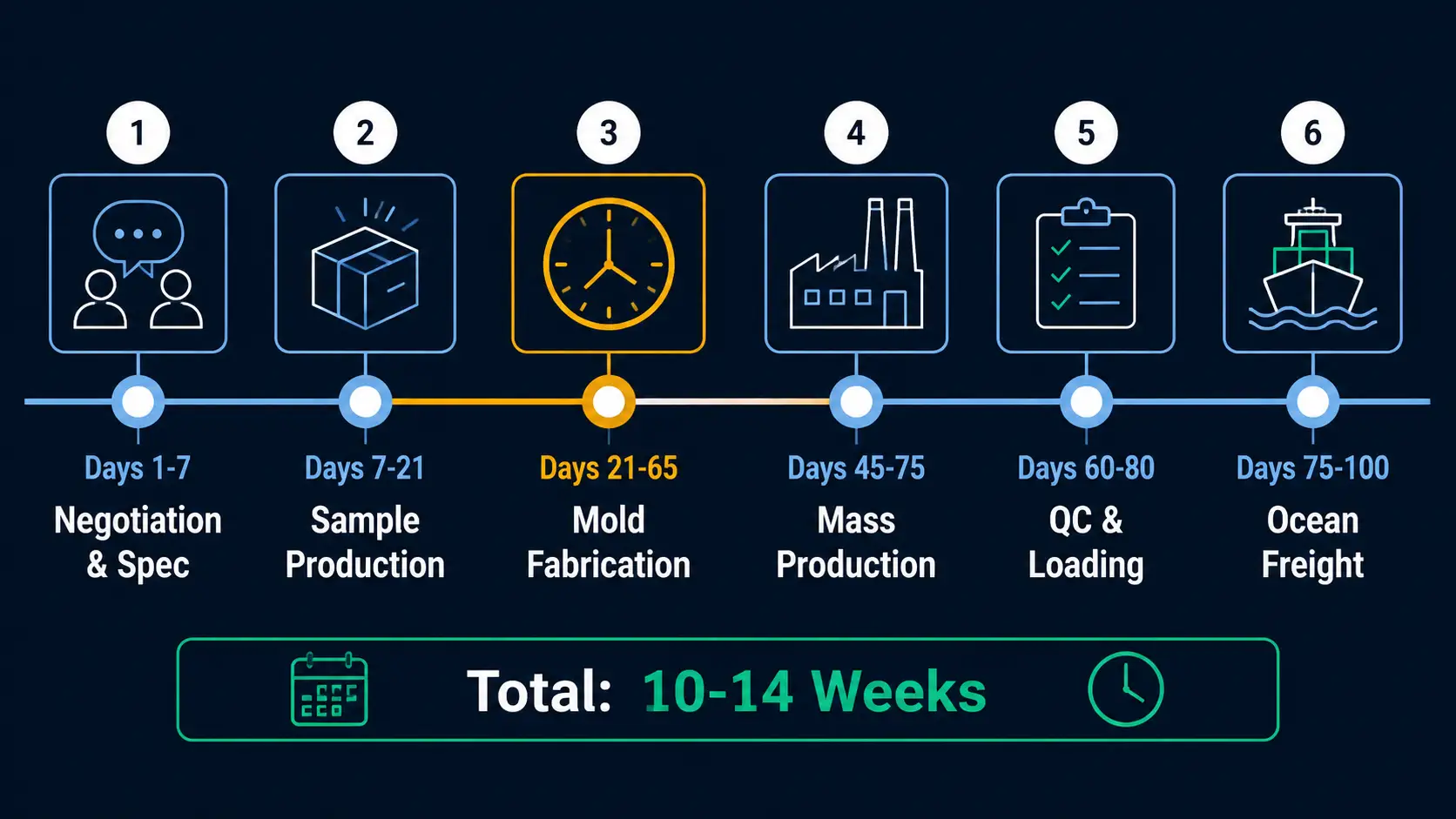
A realistic timeline for a first custom order:
- Days 1–7: Negotiation, spec confirmation, sample order placed.
- Days 7–21: Sample production and approval.
- Days 21–65: Mold fabrication (25–45 days) + production scheduling.
- Days 45–75: Mass production (15–25 days depending on volume).
- Days 60–80: Quality inspection, packing, container loading.
- Days 75–100: Ocean freight (14–30 days depending on route).
That's 10–14 weeks from first contact to goods at your door. Rush orders are possible but cost 15–25% more, and some factories won't guarantee quality on a rushed timeline. Plan for the full window.
10. Not Calculating Container Utilization
Glass bottles are heavy. A standard 20GP container maxes out at roughly 28,200 kg — and you'll hit that weight limit well before filling the volume. What this means in practice:
- The container might be only 40–60% full by volume.
- Your per-unit freight cost is higher than you'd estimate from a volume calculation alone.
- Using lighter bottles (NNPB process) can fit 20–35% more units in the same container.
Ask your supplier for their pallet configuration: bottles per layer, layers per pallet, pallets per container. Then calculate freight cost per unit before committing. A container loading calculator makes this straightforward.
11. Overlooking Import Regulations
Glass bottles for food and beverage contact need to comply with destination market regulations:
- US market: FDA 21 CFR 177.1520 (food contact). Your supplier needs to provide a compliance letter or test report.
- EU market: Regulation EC 1935/2004 (food contact materials) + REACH compliance.
- Alcohol products: TTB labeling requirements (US), excise duty markings (EU).
- Customs classification: Glass bottles typically fall under HS code 7010.90. Duties range from 0–12% depending on the country and any applicable free trade agreements.
Don't leave this until the goods arrive at port. Sort it out during the negotiation phase.
12. Treating It as a One-Off Transaction
Chinese business culture values long-term relationships — guanxi. A factory that sees you as a one-time buyer will prioritize larger, repeat customers over your order. Some practical ways to build goodwill:
- Pay on time, every time. This matters more than almost anything else.
- Visit the factory if your annual spend exceeds $50,000. Face-to-face meetings carry real weight.
- Give constructive feedback on quality. Most Chinese factories genuinely want to improve — they just need specific, actionable information, not vague complaints.
- Consolidate orders rather than placing many small ones.
The Bottom Line
Sourcing glass bottles from China can cut your per-unit cost by 30–50% compared to domestic options. But only if you treat it as a supply chain process — with specifications, inspections, and contracts — rather than a simple purchase. The upfront work pays for itself on the first order.
If you're planning your first order and want to compare bottle specs or calculate container loading before you reach out to suppliers, the tools on this site are built for exactly that.