
Here's a scenario that plays out more often than you'd expect: a buyer orders 50,000 glass bottles and 50,000 caps, both labeled "28mm." The caps don't fit. The threads don't engage. The shipment is unsellable.
The neck finish — the top portion of the bottle where the closure attaches — seems simple. It's not. There are multiple competing systems, and within each system, subtle dimensional differences that make or break the seal. This guide walks through the main closure types, the common mismatches, and how to specify neck finish so your caps fit the first time. For help with other procurement pitfalls like MOQ and payment terms, see our sourcing from China guide.
The Four Closure Systems
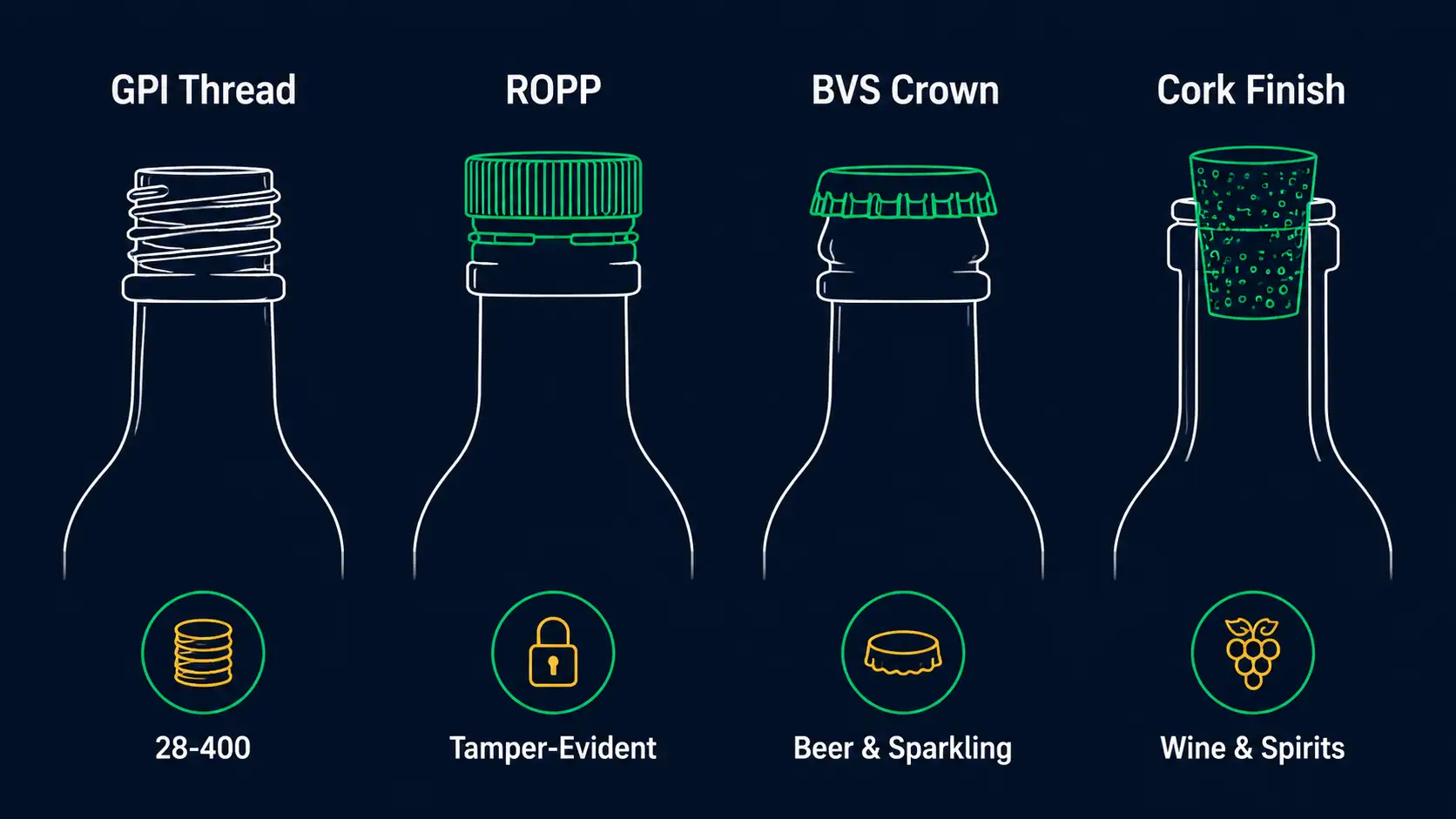
Glass bottles use one of four primary closure systems. Each has its own sizing convention, and they are not interchangeable.
GPI (Glass Packaging Institute) continuous thread. The workhorse for food, cosmetic, and pharmaceutical bottles. Specified with two numbers: diameter and thread style. A 28-400 designation means 28mm diameter with GPI 400-style thread profile. The thread style determines how many turns to seal, thread depth, and pitch.
ROPP (Roll-On Pilfer-Proof). An aluminum cap rolled onto a threaded glass neck. Standard for spirits, wine, olive oil — any product where tamper evidence matters. Common sizes: 25mm, 28mm, 30mm, 31.5mm. The cap starts as a smooth shell and gets its threads formed directly onto the bottle's neck during application.
BVS (Bague à Vis Sertie) / Crown. Press-on crown caps for beer, cider, and sparkling beverages. Includes both pry-off and twist-off crowns. Standard sizes: 26mm, 29mm.
Cork finish. A straight-sided bore for natural or synthetic corks. Sized by cork diameter: #7 (19mm), #8 (20.5mm), #9 (22mm), #10 (23.5mm).
GPI Thread Sizes: The Complete List
The GPI system uses a two-part designation — diameter-thread style — and both numbers must match between bottle and cap.
Common sizes in glass bottle sourcing:
- 18-400: Dropper and vial bottles (5–30ml)
- 20-400: Small cosmetic and pharmaceutical bottles (10–60ml)
- 22-400: Small cosmetic bottles (15–60ml)
- 24-400: Medium bottles (60–250ml) — Woozy bottles, small Boston Rounds
- 28-400: The most common size for larger bottles (120–1000ml) — Boston Rounds, jars
- 33-400: Wide mouth jars (250–1000ml)
- 38-400: Extra wide mouth jars (500ml+)
Thread styles (400, 410, 415, 425, 444) differ in profile — how many turns to seal, thread depth, and pitch. A 28-400 cap will not thread onto a 28-410 neck, even though the diameter is identical. Always match both numbers.
Why "28mm" Doesn't Guarantee Fit
The single most common source of mismatch is assuming that matching the diameter is enough. It's not. Here are the specific pitfalls:
Same diameter, different thread style. A 28-400 cap won't engage with a 28-410 neck. The thread pitch and profile are different. This is the #1 cause of cap-bottle incompatibility.
Metric vs. imperial sizing. Some caps use inch-based dimensions that are close to but not identical to metric sizes. 24mm is close to 1 inch but not the same. Never assume conversions — use the exact GPI designation.
Plastic cap vs. metal cap tolerance. Plastic continuous-thread caps are forgiving of slight dimensional variation. Aluminum ROPP caps are not — they need neck ID tolerance within ±0.15mm. If your bottle's neck is slightly out of spec, the ROPP cap will either not seat properly or seal inconsistently.
Tamper band interference. ROPP caps have a tamper-evident band that has to clear the bottle's neck ring. If the neck ring is too tall or positioned incorrectly, the cap can't seat fully.
Liner mismatch. Caps come with different liner materials — EPE foam, pulp/poly, pressure-sensitive, induction seal. The liner must match the bottle's sealing surface. A cork-finish bottle needs a different liner than a flat-top GPI finish. Using the wrong liner means poor seals and potential leaks.
How to Specify Neck Finish Correctly
When you order glass bottles, include these five specifications:
- Closure system: GPI, ROPP, BVS, or Cork.
- Full designation: "28-400," not "28mm."
- Tolerance: For ROPP, specify neck ID tolerance (typically ±0.15mm).
- Sealing surface: Flat top (CT caps), crown lip (crowns), or cork bore.
- Closure reference: If possible, name a specific cap model — "compatible with Mold Rotor cap 28-400-ALU-ROPP" removes all ambiguity.
Test Before You Commit
Before full production, test-fit at least 50 caps on 50 bottles from the production run. Check four things:
- Thread engagement: Does the cap screw on smoothly for the full thread count?
- Torque-to-seal: Measure with a torque wrench. Typical range: 10–18 in-lbs for GPI, 15–25 in-lbs for ROPP.
- Leak test: Fill with water, cap, invert, apply gentle pressure. No drips.
- Cross-threading: Can a hurried operator mis-thread the cap? If yes, the thread profile may be too shallow — a production-line problem waiting to happen.
Quick Reference: Neck Finish by Bottle Type
| Bottle | Size | Neck Finish | |--------|------|-------------| | Boston Round | 15–60ml | 18-400 or 20-400 | | Boston Round | 120–250ml | 24-400 | | Boston Round | 500ml+ | 28-400 or 33-400 | | Woozy | 60–150ml | 24-400 | | Woozy | 300ml+ | 28-400 | | Bordeaux / Burgundy | 750ml | Cork #8 (20.5mm) | | Champagne / Sparkling | 750ml | 26mm BVS crown | | Spirits | 200ml+ | ROPP 28mm | | Dropper | 5–30ml | 18-400 | | Jars | 250ml+ | 38-400 or 58-400 |
Mismatched caps and bottles are one of the top reasons first-time glass buyers end up with dead inventory. It takes 5 minutes to verify compatibility and 5 months to recover from a wrong order. Specify early, test early. You can also use our neck finish reference tool to look up the correct designation for any bottle type, and the glass bottle mold cost guide to understand the other major cost variable in your first order.