Glass color is one of the earliest decisions in any packaging project, and it sets off a chain reaction: cost per unit, minimum order quantity, production lead time, which factories can even take your order, and how well your product is protected on the shelf. Here's what actually changes when you pick one color over another. For a broader look at how color fits into the total cost of a glass bottle order, see our mold cost guide and sourcing from China guide.
Where Glass Color Comes From
Container glass gets its color from metal oxides added to the soda-lime raw material batch during melting:
- Flint (clear): No intentional colorants. But this doesn't mean it's the cheapest — flint glass requires ultra-low-iron silica sand (less than 0.015% Fe₂O₃), and decolorizers like selenium or cobalt to neutralize the residual green tint from trace iron.
- Amber (brown): Iron oxide + sulfur + carbon compounds. Total coloring oxides: 0.4–0.8%. These are cheap, abundant materials.
- Green: Iron oxide + chromium oxide. Light green uses ~0.25% Fe₂O₃ with trace Cr₂O₃. Emerald green pushes the Cr₂O₃ higher (0.1–0.2%).
- Cobalt blue: Cobalt oxide (Co₃O₄) at 0.01–0.05%. Cobalt oxide runs ~$25–40/kg — the most expensive colorant in common use.
- Frosted: Not a glass color at all. It's a surface treatment — acid etching or sandblasting applied after the bottle is formed. The base glass can be any color.
What Each Color Costs
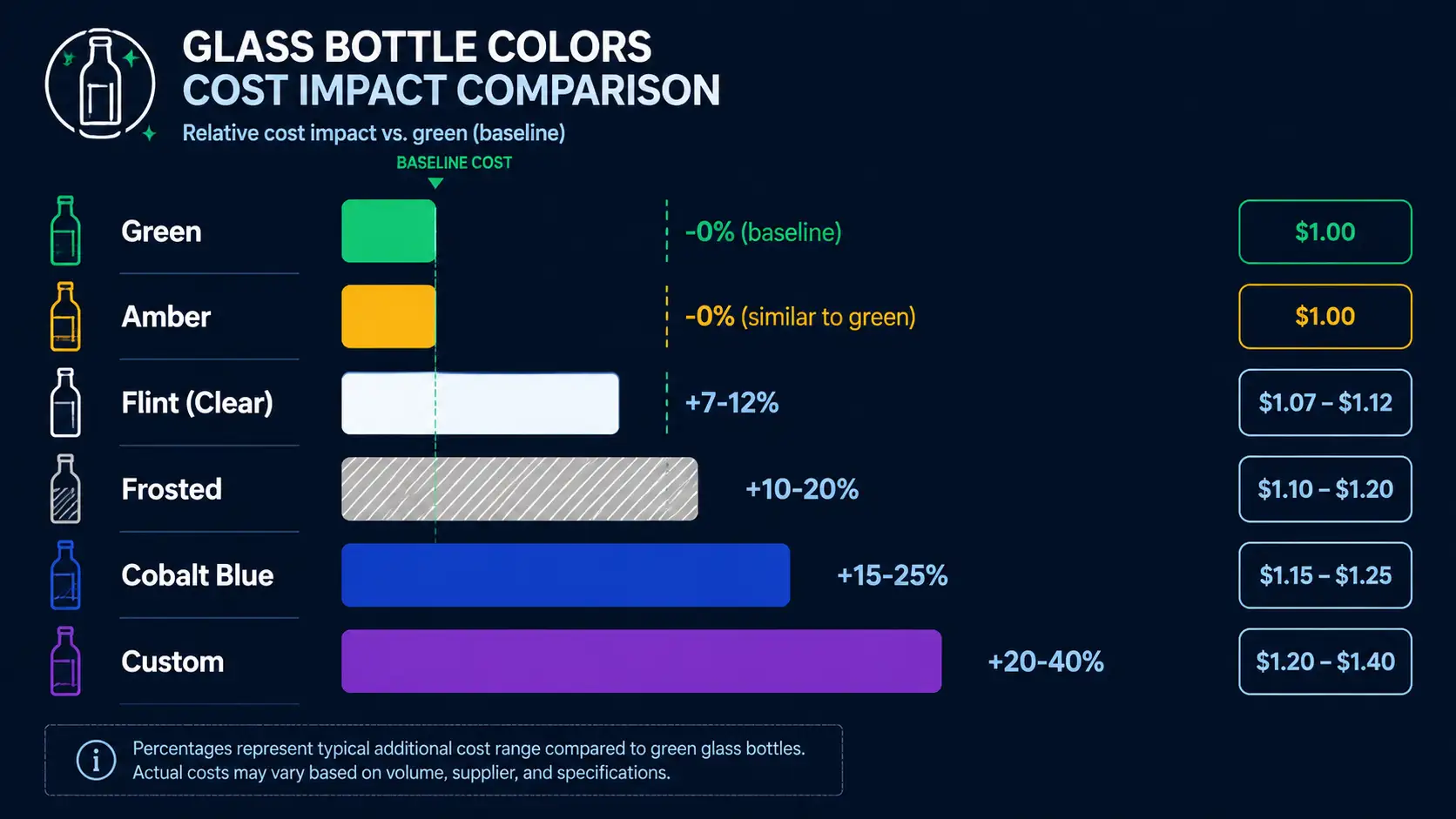
Color affects cost through three channels: the price of the colorant itself, the raw material purity requirements, and how the factory handles cullet (recycled glass).
Amber and green use cheap colorants (iron, chromium). They're often priced similar to or slightly below flint because cullet purity requirements are more relaxed — the factory can use more recycled content without worrying about color contamination.
Flint (clear) has no colorant cost, but needs high-purity silica sand and carefully sorted flint cullet. Flint cullet trades at a $45/ton premium over mixed-color cullet. Net result: 7–12% more expensive than standard green at most factories.
Cobalt blue carries the cobalt oxide surcharge. Adds 15–25% to the base bottle price.
Frosted is a secondary acid-etching process on top of the base bottle cost. Adds 10–20%.
Custom colors (black, red, specialty tints) require multiple colorants and dedicated production runs. Premium runs 20–40% above standard.
How Color Changes Your MOQ
Glass furnaces run at 1,500–1,600°C, 24 hours a day. Switching color means draining the furnace, flushing the system, and recharging — a 1–3 day process that wastes tonnes of glass. Factories schedule color runs in batches, and your MOQ depends on when the next batch is:
- Flint, amber, green: Most factories run these weekly. Standard MOQ applies (5,000–20,000 units).
- Cobalt blue: Fewer factories produce it, batches are less frequent. MOQ typically 1.5–2× standard.
- Frosted: The base bottle follows its color's MOQ. Frosting itself adds a minimum batch size for the etching line.
- Custom colors: Factories may require 50,000+ units to justify dedicating a furnace run.
Lead Time Differences
- Standard colors (flint, amber, green): No extra lead time if the factory has an upcoming run. If their next amber run is three weeks away, you wait three weeks.
- Cobalt blue: Add 1–2 weeks for scheduling into the next cobalt batch.
- Frosted: Add 3–7 days for the acid-etching step after forming and annealing.
- Custom colors: Add 2–4 weeks. You might wait for the factory's next color-change window.
UV Protection: Not Just Aesthetic
Color choice directly affects product shelf life:
- Flint transmits ~90% of visible light with negligible UV blocking. Fine for products that don't degrade in light. If your product is light-sensitive and you insist on clear glass, plan for secondary packaging (boxes, sleeves, UV-blocking labels).
- Green blocks 50–85% of UV-B (280–315nm). Moderate protection — think of it as the baseline for colored glass.
- Amber blocks more than 90% of UV-A and UV-B. Required by USP chapter 661.2 for light-sensitive pharmaceuticals. This is why virtually all beer and medicine bottles are amber.
- Cobalt blue offers moderate UV protection plus visible blue light filtering. The UV performance isn't as good as amber, but the shelf presence is stronger for many brands.
Cullet and Recycling
Your color choice affects recyclability and the factory's willingness to use recycled content:
- Amber and green tolerate mixed cullet — up to 80%+ recycled content.
- Flint requires sorted flint cullet. Even 1% green cullet contamination produces a visible tint.
- Cobalt blue cullet is scarce. Factories producing cobalt bottles use more virgin material, which contributes to the higher price.
If your brand makes sustainability claims, this matters. A green bottle with 70% recycled content and an amber bottle with 75% recycled content both beat a cobalt blue bottle with 25% recycled content on circularity metrics, even though the cobalt blue bottle "looks" more premium. For a deeper comparison of the environmental trade-offs between glass and PET, see our glass vs PET guide.
How to Choose
Product protection first, brand positioning second, cost third. Here's the framework:
- Light-sensitive product (beer, pharmaceuticals, olive oil, some cosmetics): Amber. Cost-neutral, best protection, no trade-off.
- Product visibility is your selling point (premium spirits, honey, craft kombucha): Flint. Budget 7–12% more. Consider if the visual benefit justifies the cost for your specific product.
- Brand differentiation + moderate protection: Green. The cheapest colored option, decent UV blocking.
- Premium / luxury brand where shelf impact matters more than unit cost: Cobalt blue. The 15–25% premium is a marketing line item, not a packaging cost.
- Premium tactile feel is the goal: Frosted over any base color. Add 10–20% and 3–7 days.
The right color choice prevents customer complaints and returns. That saves more money than whatever you save per bottle by picking the cheapest option.