
The glass-versus-plastic debate doesn't have a clean answer. Both materials have genuine strengths and real trade-offs. This guide compares them across five dimensions — carbon footprint, recyclability, cost, product protection, and consumer perception — so you can pick the right material for your specific product and market, not the one that wins a generic argument. If you've already decided on glass, our sourcing from China guide covers the full procurement process.
Carbon Footprint
Manufacturing emissions per 500ml bottle (cradle-to-gate):
- Glass (30% recycled content): 300–450g CO₂e per bottle.
- Glass (virgin): 500–700g CO₂e per bottle.
- PET (virgin): 70–120g CO₂e per bottle.
- PET (100% rPET): 40–70g CO₂e per bottle.
PET wins here, and it's not close. Glass melts at ~1,500°C; PET processes at ~250°C. But manufacturing is only one piece of the lifecycle. Transportation tips the scales further for heavy goods:
- A 40HQ container holds ~28,000 glass bottles or ~120,000 PET bottles (same 500ml capacity).
- Shipping 100,000 glass bottles from China to the US generates ~12–18 tonnes of CO₂ from freight alone.
- Shipping 100,000 PET bottles over the same route: ~3–5 tonnes.
Across the full lifecycle (production + transport), glass generates 3–5× more CO₂ per bottle. The gap narrows if the glass is produced locally (short transport) and recycled at high rates (less virgin material). But for a typical China-to-US supply chain, PET has a clear carbon advantage.
Recyclability
Glass
- Glass can be recycled indefinitely without quality loss. No polymer degradation.
- Recycling rates: EU ~76%, US ~31%, China ~25%.
- In the EU, ~80% of collected glass gets remelted into new containers — a strong closed loop.
- Sorted flint cullet trades at a premium ($45/ton over mixed). Amber and green cullet are also marketable.
- The main constraint: color sorting. Mixed-color cullet can't produce clear glass.
PET
- PET degrades with each recycling cycle. Most rPET gets downcycled into fiber, strapping, or sheet — not new bottles.
- Recycling rates: EU ~58%, US ~29%, China ~20%.
- Only ~20–30% of collected PET becomes new bottles. The rest exits the bottle loop permanently.
- Food-grade rPET requires extensive cleaning and decontamination. Supply is constrained.
- Main constraint: contamination from labels, adhesives, and mixed plastics, plus collection infrastructure gaps.
The bottom line on recycling: glass has a theoretically stronger closed loop — infinite recyclability, no degradation. PET's bottle-to-bottle recycling is growing but still limited. Both materials suffer from collection gaps outside the EU.
Cost Comparison
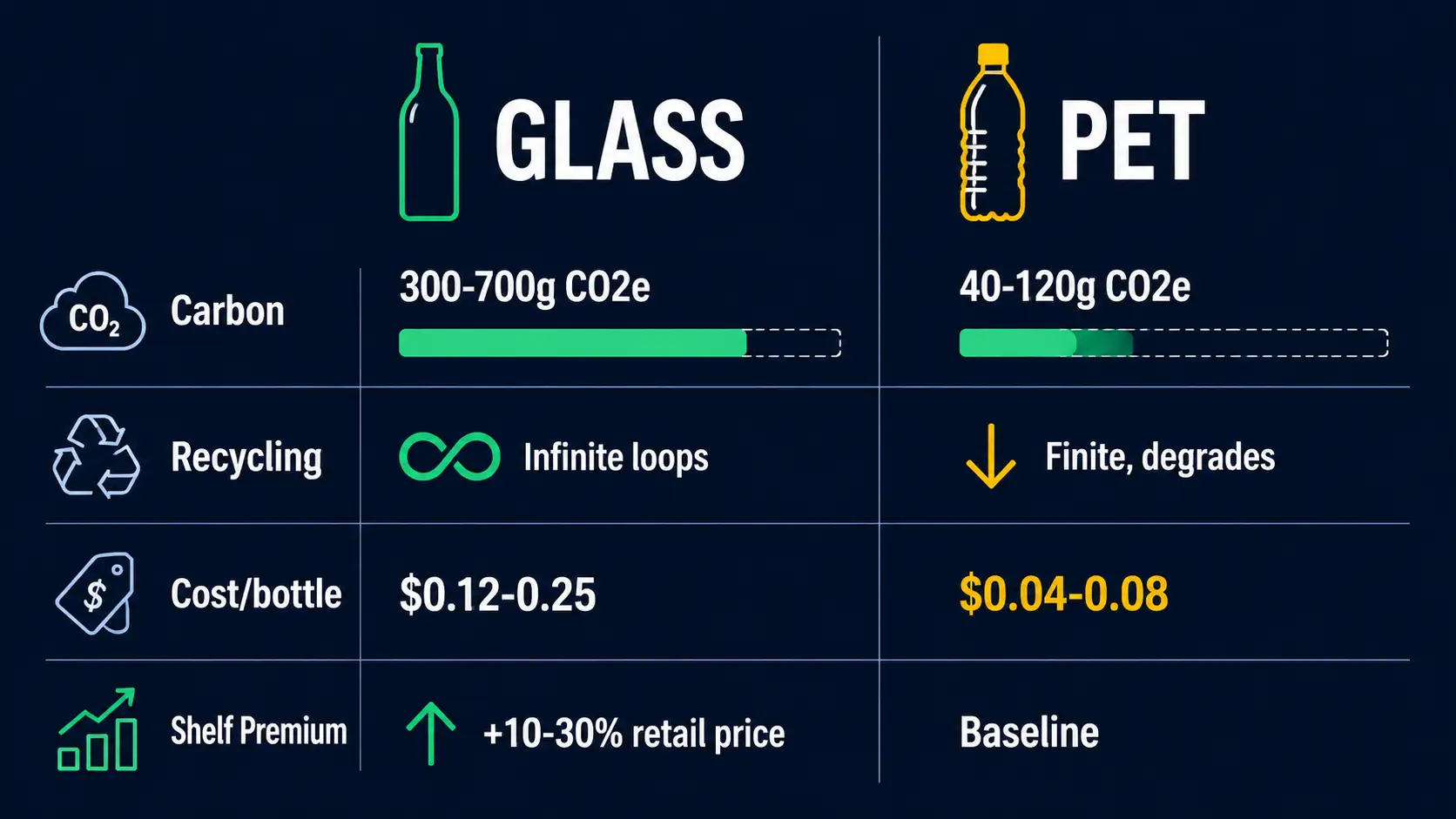
Per-unit cost for a 500ml bottle (FOB China, 50,000 units):
- Glass bottle (flint, B&B): $0.15–0.25
- Glass bottle (amber, NNPB lightweight): $0.12–0.20
- PET preform + blow molding: $0.04–0.08
- 100% rPET bottle: $0.06–0.12
PET costs 50–70% less per unit. But the comparison doesn't stop at the bottle price. Freight, filling equipment, and breakage all factor in — and glass bottles being heavier means per-unit shipping cost is 3–4× higher. Our container loading guide explains how to minimize that gap.
- Freight: Glass costs 3–4× more to ship per unit because of weight.
- Filling line: Glass requires heavier-duty conveyors, handling equipment, and breakage management.
- Breakage: Glass has a 1–3% breakage rate through the supply chain. PET is virtually unbreakable.
- Premium pricing offset: Products in glass consistently command 10–30% higher retail prices than the same product in PET. The bottle cost difference often gets absorbed by the price premium consumers will pay.
Product Protection
Where the materials actually differ in performance:
Oxygen barrier. Glass is essentially impermeable to O₂. PET allows slow O₂ ingress — roughly 50–100× faster than glass. For oxygen-sensitive products (wine, olive oil, certain juices and sauces), glass extends shelf life significantly. PET works for products that aren't sensitive to slow oxidation.
UV protection. Amber glass blocks >90% UV. PET requires added UV absorbers, which increase cost and still don't match amber glass performance.
Chemical inertness. Glass doesn't interact with contents. PET can leach acetaldehyde (imparts a sweet off-flavor) and trace antimony (catalyst residue) at elevated temperatures. The levels are within food-safety limits for properly manufactured PET, but the perception matters for some product categories — and this is one reason why glass color choice also matters: amber glass blocks UV that can accelerate these chemical interactions.
Temperature resistance. Glass handles hot-fill (>85°C), retort sterilization, and pasteurization. PET deforms above 70°C unless heat-set — which adds cost and still doesn't match glass.
Pressure. Glass Champagne bottles withstand 6+ bar. PET carbonated bottles top out at ~4 bar.
For products where shelf life and product integrity are non-negotiable — wine, spirits, olive oil, pharmaceuticals, hot-fill sauces — glass is the safer technical choice. For shelf-stable, non-sensitive products (water, some CSDs, personal care), PET performs adequately.
Consumer Perception
Multiple consumer studies consistently show that packaging material affects buying decisions:
- Quality perception: 70%+ of surveyed consumers rate the same product as "higher quality" when it's in glass versus plastic.
- Price acceptance: Glass triggers a 10–30% higher willingness-to-pay for the same product.
- Sustainability perception: Consumers tend to overestimate glass's environmental benefit and underestimate PET recycling. Glass "feels" more sustainable to most buyers, even though the carbon footprint tells a more complicated story.
- Health concerns: Worries about microplastics and chemical leaching from PET are growing. Glass is perceived as safer, regardless of the actual food-contact safety data.
These perceptions aren't always accurate — PET is safe for food contact when properly manufactured — but they're real market forces that affect how your product sells.
How to Decide
Choose glass when:
- Your product is light-sensitive, oxygen-sensitive, or requires hot-fill or pressurization.
- You're positioned as premium, artisanal, or craft.
- You sell in markets with high glass recycling rates (EU).
- Your product is wine, spirits, olive oil, pharmaceuticals, premium sauces, or craft beverages.
Choose PET when:
- Per-unit cost is the binding constraint.
- Your product is shelf-stable and not oxygen-sensitive.
- Shatterproof packaging matters (outdoor events, travel retail, sports venues).
- Weight is a factor for e-commerce shipping.
Choose both when:
- You sell the same product in retail (glass for shelf presence) and online/DTC (PET for shipping cost).
- Your market spans premium and value segments.
The material choice isn't binary. A packaging strategy that uses each material where its strengths matter most beats a one-size-fits-all approach every time.